

A transparent response to recent community concerns.
Over the past day, we’ve seen thoughtful questions and concerns from the community around LVMON, LVUSD, and the current user experience on LeverUp.
This article aims to clearly explain our design choices, acknowledge what isn’t good enough yet, and outline exactly what we’re doing next.
We believe transparency is not optional — especially for an LP-free, on-chain trading protocol.

1. Why are users settled in LVMON or LVUSD?
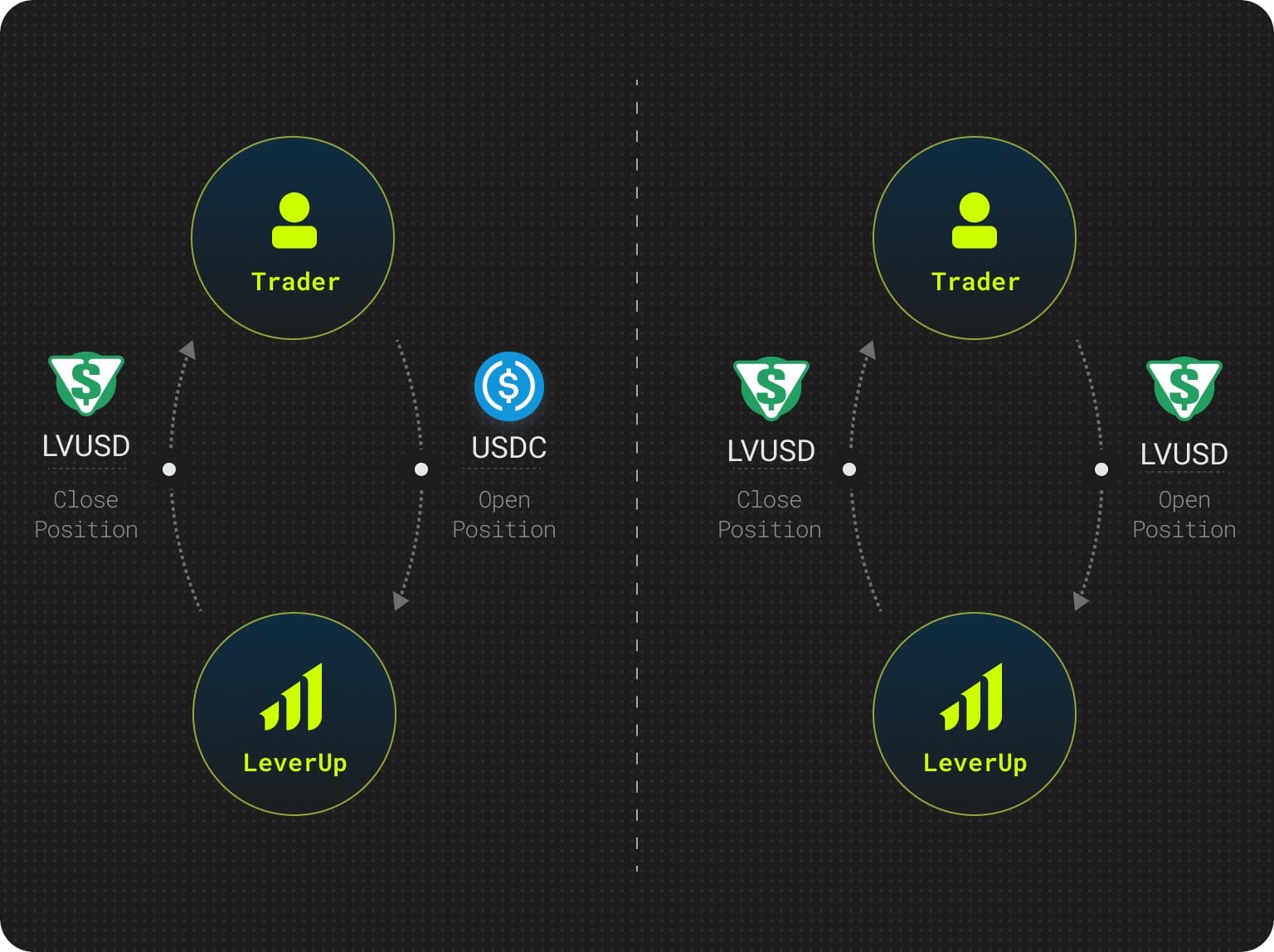
LeverUp’s settlement design is not an isolated decision — it is deeply tied to LV’s ve(3,3) tokenomics, specifically the xLV / yLV framework.
At a high level:
- LVUSD and LVMON are not just “synthetic tokens”
- They are structural components of how value, fees, and incentives are distributed inside the protocol
- The full economic loop only completes after LV Season 1
Since season 1 has not yet concluded, what users currently see on-chain are mostly third-party pools.
This can understandably create confusion if viewed without context.
To ensure reliability during this phase,
LeverUp dApp is already integrated with the official LVUSD<>USDC PancakeSwap pool, providing a transparent and verifiable trading route and the official LVMON<>MON pair is also live.

VMMV (Virtual Market Making Vault)
LeverUp introduces a unique Virtual Liquidity Pool, called the VMMV (Virtual Market Making Vault).
This mechanism acts as the automated market-making counterparty, with each asset supporting its own open interest limits and leverage parameters.
As a result, perpetual trading is no longer constrained by TVL size or asset availability.
This design also allows any verified token to be used as collateral, with each token managed in its own independent trading pool.

Learn more about how LV’s ve(3,3) mechanism works
https://leverup.gitbook.io/docs/liquidity-layer/trader-flywheel/tokenomics
2. Redemption & Swap friction
A fair criticism we’ve received is that:
“Users are not clearly told what they can or cannot do with LVMON”
That feedback is valid
While traders can continue trading using LVMON, our in-app messaging and system guidance were not clear enough, especially for first-time users.
What we’re actively shipping
These concerns were not ignored — they were already on our internal roadmap:
Redemption module
- A standalone redemption system
- Does not rely on LV ve(3,3)
- Lives directly inside the LVUSD & LVMON Exchange module
Official LVMON<>MON pool
- First-party liquidity
- Lower slippage
- Reduced dependency on community-made pools
Official pools are live and redemption is scheduled this week
We’ve also rolled out clearer in-app prompts already and will continue improving system-level guidance. Once the PRD is finalized, we actively welcome feedback from experienced community members.
3. About the audit comments on settlement & compensation
Some concerns referenced an audit note suggesting settlement risks.
It’s important to clarify:
The audit section in question explicitly refers to LeverUp’s LP-free architecture.
LeverUp is intentionally designed without LP-provided liquidity.
Why?
- LP-based perp DEXs sacrifice capital efficiency
- A significant portion of fees must compensate LPs
- Traders are structurally disadvantaged
LeverUp flips this model:
- Traders are the primary economic participants
- 100% of protocol trading fees are shared with traders
- No LP subsidy layer exists
As the audit itself states from the team side:
“This is by design for better capital efficiency.”
This is not an oversight — it is a core architectural choice.
Learn More
https://leverup.gitbook.io/docs/liquidity-layer/lvusd-stablecoin#price-stability-and-twap-anchoring
4. On Lumiterra and protocol liquidity
There’s a misconception that:
“LeverUp is paying Lumiterra users.”
In reality, it’s the opposite.
Lumiterra is effectively paying into LeverUp.
Because LVMON is used as an in-game currency:
- Lumiterra provided early liquidity
- A meaningful share of current pool balances come from real game users
- Not mercenary or farm-and-dump capital
Closing thoughts
LeverUp is building a trader-first, LP-free perpetuals protocol.

That path comes with:
- Non-standard mechanics
- Transitional phases
- Higher responsibility on communication
Some things were not communicated well enough, we’re getting to improve that.
But the core architecture is intentional, audited, and designed for long-term capital efficiency and trader alignment.
We’ll continue shipping and improving — publicly and on-chain.
If you have questions, critiques, or ideas, we want to hear from you. (
Monad is a new chain with a passionate community. Let’s build something people want and great together.