

What You Can Do When Category Labs Announces an $80M Buyback for $MON
Recently, Category Labs @category_xyz updated its $MON buyback plan, expanding the scale from $30M to $80M. That is a very meaningful move, and one that could provide strong support for $MON's current market structure.
So what should you do next?
You can choose to DCA into $MON, or wait for what you believe is the right entry and build your bag accordingly.
But simply letting your $MON sit idle in your bag may mean missing potential staking utility.
Native MON staking currently shows double-digit annualized yield on supported staking interfaces — users should check live rates — and compared with many other chains, the exit conditions are relatively simple. So if you are holding $MON, you should seriously consider putting it somewhere that makes your bag heavier over time.
The most common path is to search for MON staking protocols and pick the one that best fits your preference.
That is also the reason I'm writing this article: to introduce another option.
Why LVMON Staking Is Worth Looking At
About a month ago, LeverUp launched the $LVMON staking module.
Note: LVMON is the synthetic token at the core of LeverUp. Every position on the protocol is denominated and settled in it. LVMON is minted 1:1 by depositing MON as collateral.
At the moment, LeverUp $LVMON staking offers dynamic APY paid in LVMON, with no fixed lock-up; redemption availability depends on the selected route and liquidity conditions. APY changes based on how much LVMON is actively staked relative to the total vault. For the current rate, check the staking page directly.
If you are interested in the deeper, more technical math behind how the yield is generated, refer to: LVMON Stake: Yield Source, APY Formation, and Transparency.
How to Get and Stake LVMON
Right now, access is open to users who supported LeverUp from day one of Monad mainnet — including $LVMON holders, $LV holders, and LeverUp perps traders. These users receive an allocated $LVMON staking quota based on their level of activity and support.
Head over to the dedicated page: app.leverup.xyz/LVMON
You have probably already noticed the APY on the page.
If you already have staking quota but no LVMON yet, that is fine. Getting from MON to LVMON is straightforward, and there are two routes:
Route 1: Official 1:1 Minting
This is the protocol-supported route. Use MON as collateral to open a position on any trading pair in any size, then close it immediately — your MON collateral will be automatically converted in full into LVMON and returned to your wallet.
One thing to note: under the current fee policy, certain high-leverage positions (500x and above) may have no open or close fees — check the app for live terms.

Route 2: Swap Through the Secondary Market
A swap aggregator is integrated directly into the page, so you can access secondary market liquidity and swap MON into LVMON in one step.
Keep in mind this route is constrained by pool depth and comes with swap fees and price impact.

Staking Your LVMON
Once your bag is full of LVMON, staking is simple.
Based on your allocated quota, choose however much LVMON you want to stake, then click Stake. Once staked, it begins accruing rewards according to the staking module's reward cycle.
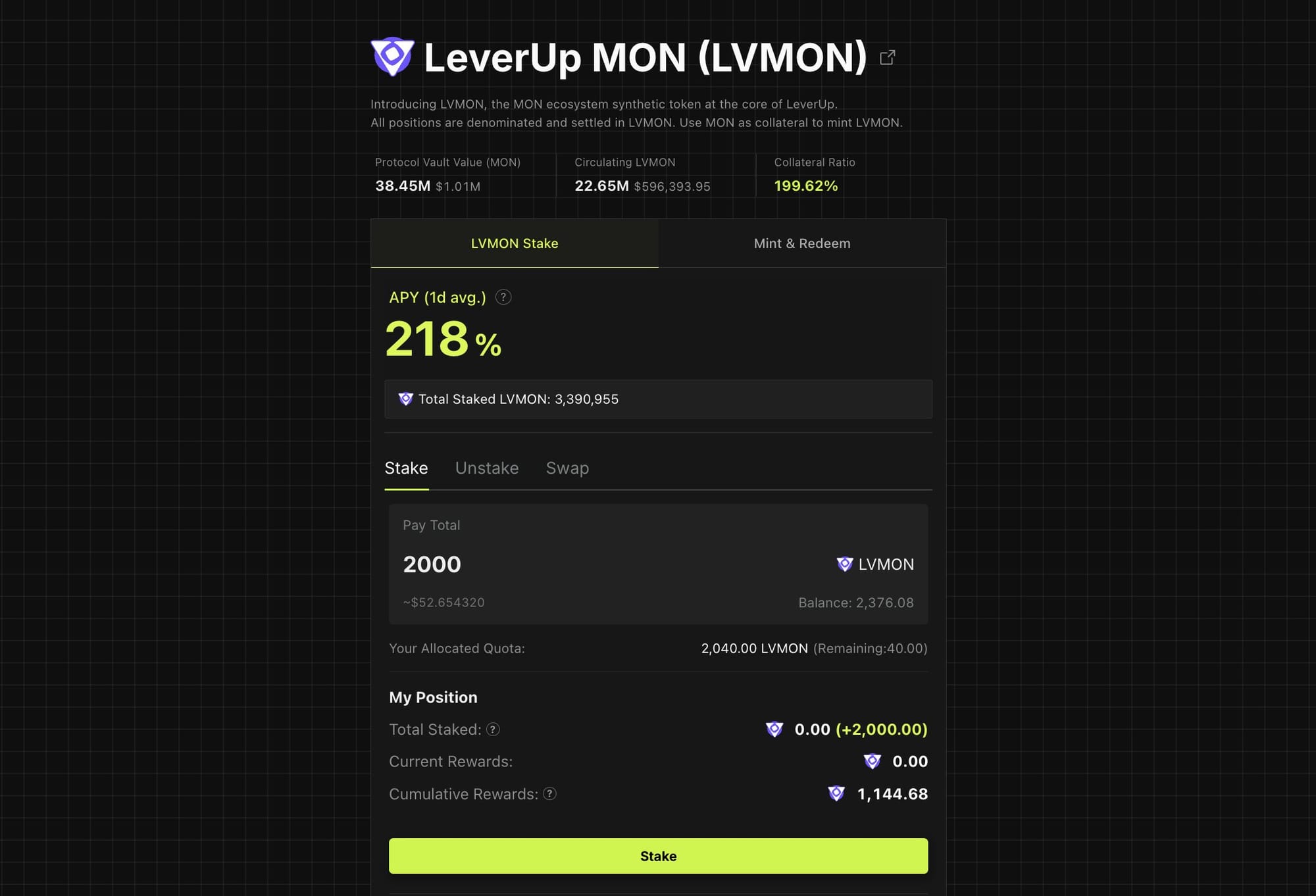
The My Position section shows three key metrics:
- Total Staked — your principal plus currently accrued rewards
- Current Rewards — rewards accrued so far in this cycle
- Cumulative Rewards — total rewards earned historically, including current accruals
Unstaking and Redeeming
Unstaking is just as simple. There is no lock-up period — you can choose any amount to unstake at any time.
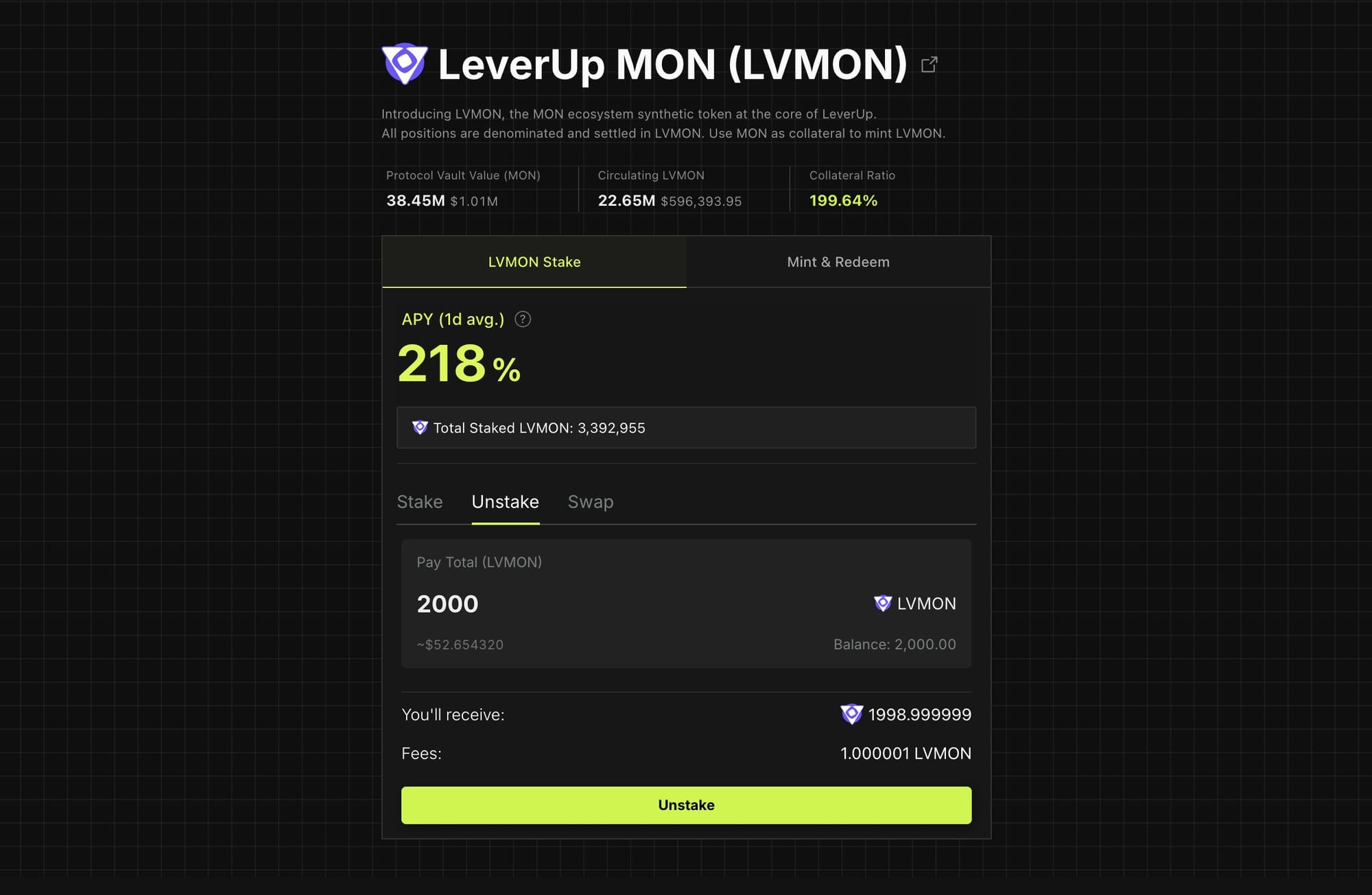
Redeeming LVMON back into MON has three paths:
1. Normal Redeem — Notifies the validator to begin the delegated unstaking process. Due to the confirmation flow at the MON node and validator level, this takes roughly 10 hours to complete. After that, return to the page and claim the corresponding MON.
2. Fast Redeem — LeverUp maintains its own buffer pool. Through this route, you can redeem directly into MON and exit faster, subject to buffer availability and applicable conditions.
3. Secondary Market — Use the swap route in reverse to convert LVMON back into MON through secondary market liquidity.

A Cleaner Way to Put Your Bag to Work
A bigger MON buyback may strengthen the market structure. But what you do with your own bag still matters.
Holding MON is one thing. Putting it to work is another.
With LVMON Staking, LeverUp gives MON holders a path to do more than just wait. You can mint into LVMON, stake it, earn from the productive side of the vault, and redeem back out through your preferred route. At the same time, LVMON remains the core synthetic asset of LeverUp and can also be used as collateral for perps trading. The staking flow is designed around flexible unstaking, multiple redemption routes, and direct use of LVMON within LeverUp.
This is only one step in a much bigger roadmap, but it already makes one thing clear: on LeverUp, core assets are not meant to sit idle.
They are meant to work.