
You don't have to sell your MON to trade. AnyCollateral lets you use Monad ecosystem tokens directly as margin — keeping your holdings intact while you trade.
What This Guide Covers
- What AnyCollateral is and why it matters
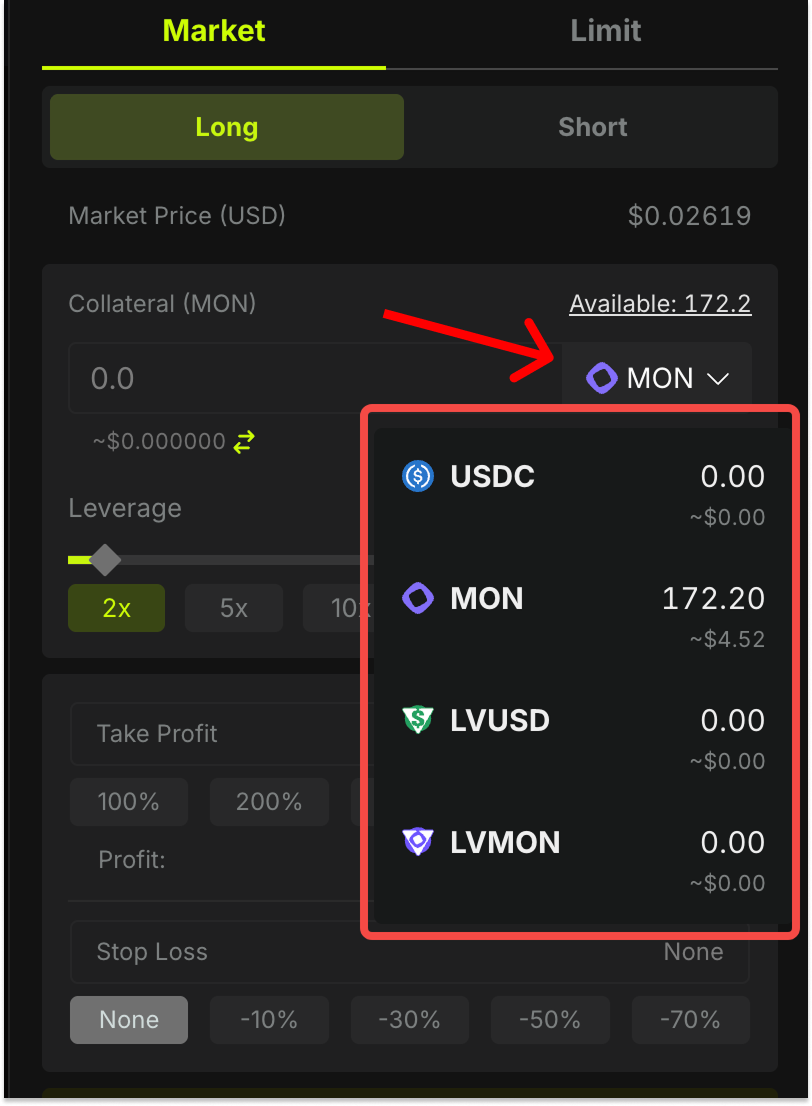
- Currently supported collateral assets
- What Collateral Ratio (CR) means and how it affects your margin
- How to select your collateral when opening a trade
- The vision for AnyCollateral going forward
Before You Start
- You've read How to Open Your First Trade
- You hold one of the supported collateral assets in your wallet: USDC, MON, LVUSD, or LVMON
What Is AnyCollateral
Most perp exchanges require you to convert everything into USDC before you can trade. That means selling your MON — taking on price exposure you may not want, and triggering a taxable event in many jurisdictions.
LeverUp's AnyCollateral program changes this. You can use your existing Monad ecosystem tokens directly as collateral to open positions, without selling them first. Your tokens stay in your control as margin; you get the trading exposure you want.
Currently Supported Assets
| Asset | Type | Notes |
|---|---|---|
| USDC | Stablecoin | 1:1 collateral value |
| MON | Monad native token | Collateral Ratio applies |
| LVUSD | LeverUp stablecoin | — |
| LVMON | LeverUp MON synthetic | Collateral Ratio applies |
What Is the Collateral Ratio (CR)
Not all assets are equal as collateral. Each supported asset has a Collateral Ratio (CR) between 0% and 100%, set based on the asset's liquidity and price volatility.
How it works:
Available margin = Deposited value × Collateral Ratio
For example, if MON has a CR of 70%:
- You deposit $100 worth of MON
- Your available margin = $100 × 70% = $70
USDC has a CR of 100% — $100 USDC gives you $100 of margin.
The CR exists because volatile assets can lose value quickly. A lower CR gives the protocol a buffer to handle that risk safely.
How to Select Your Collateral When Opening a Trade
- Open the order panel in app.leverup.xyz
- Choose your direction (Long or Short) and set your leverage
- In the collateral selector, choose your preferred asset (USDC, MON, LVUSD, or LVMON)
- The panel automatically calculates your available margin based on the asset's CR
- Enter your position size and confirm as normal

Things to Be Aware of With Non-Stablecoin Collateral
Using MON or LVMON as collateral introduces an extra layer of risk that doesn't exist with USDC.
Your liquidation price can change even if the market doesn't move against you. If you use MON as collateral and the price of MON falls, your available margin shrinks — which can push your liquidation price closer to your entry, even if the asset you're trading hasn't moved.
Using MON as collateral for a Long MON position = double exposure. You're long on MON through your position, and your collateral value also tracks MON's price. If MON falls, you take the loss from both directions simultaneously.
The AnyCollateral Vision
AnyCollateral isn't a one-time feature — it's a program. As more Monad ecosystem tokens demonstrate real communities and on-chain traction, they'll be reviewed and added to the supported collateral list.
The goal is for LeverUp to become the financial layer for the entire Monad ecosystem — where any Monad-native asset can serve as productive capital, not just something that sits in a wallet appreciating or depreciating.
Projects can apply to have their token added at ac.leverup.xyz.
Important Things to Know
CR values are set by the protocol and may change. Always check the current CR displayed in the interface when you open a trade — don't rely on a number from a previous session or article.
The more volatile your collateral, the more actively you need to monitor your position. A sudden drop in your collateral asset's price can bring your liquidation price closer without the market you're trading moving at all.
Common Mistakes
Assuming $100 of MON = $100 of margin. The Collateral Ratio discounts the value. Check the margin figure in the order panel after selecting your collateral — it will be lower than the token's face value if the CR is below 100%.
Using high-volatility collateral with high leverage. This stacks two risk factors: the leveraged position can move against you, and the collateral value can drop simultaneously. If you're using non-stablecoin collateral, use lower leverage to compensate.
Not monitoring open positions when using MON as collateral. Price swings in MON can affect your liquidation price even when the market you're trading is calm. Check your positions more frequently when using volatile collateral.
Risk Reminder
Non-stablecoin collateral introduces a second source of price risk. Your liquidation price moves not just with the market you're trading, but also with the price of your collateral asset. Use USDC as collateral if you want to isolate your risk to a single market.
What to Read Next
- How Liquidation Works on LeverUp — Especially important when using non-stablecoin collateral.
- How LVMON Staking Works — LVMON has uses beyond collateral — learn how staking works.
