
TL;DR
- The headline: On November 23, 2026, NVIDIA’s Board of Directors voted unanimously to reinstate Jensen Huang as President, CEO, and Board Director, effective immediately, 11 days after his November 12, 2026 resignation.
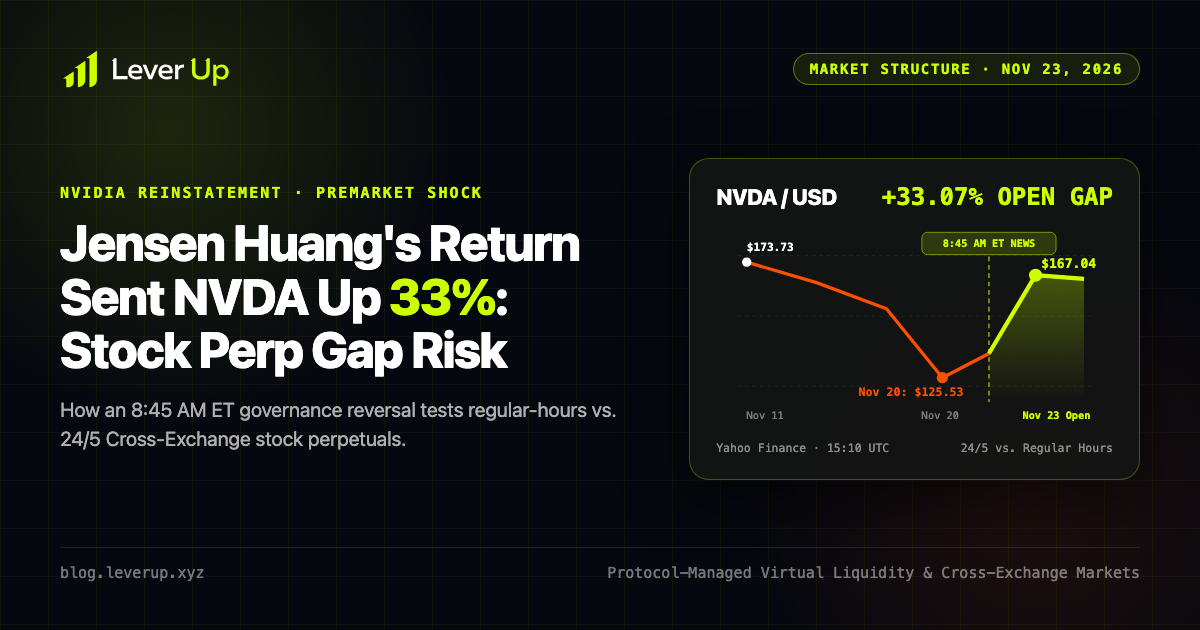
- The market shock: The announcement dropped about 45 minutes before the regular U.S. equity open. Yahoo Finance intraday data (as of 15:10 UTC, November 23, 2026) shows NVDA surged from $136.39 in premarket to $160.00 between 13:45 UTC and 14:00 UTC, gapped open at $167.04 (+33.07% above Friday’s $125.53 close), swung between $156.93 and $169.56 in the opening 40 minutes, and traded near $165.85 (+32.1%) on 309.6 million shares.
- The governance caveat: NVIDIA’s board said it received input from senior levels of the U.S. government and is confident Huang’s return poses no national security risk, while keeping the independent investigation committee, the newly established National Security and Export Control Oversight Committee, and a new Chief Compliance Officer search in place (NVIDIA Newsroom, November 23, 2026).
- The perp market-structure takeaway: An 8:45 AM ET corporate shock exposes the difference between regular-hours stock perps (where off-hours exits and liquidations pause until 9:30 AM ET) and 24/5 extended-hours routed stock perps (where premarket pricing allows immediate reaction — and active liquidation engines — before the opening bell). On LeverUp today, NVDA/USD trades as a Cross-Exchange market routed to an external order book with its own session schedule, leverage limits, and liquidation rules (LeverUp Cross-Exchange docs).
What NVIDIA Officially Announced on November 23, 2026
On November 23, 2026, NVIDIA (NASDAQ: NVDA) announced that Jensen Huang had been reinstated as President, Chief Executive Officer, and Board Director, effective immediately. The move reversed his November 12, 2026 resignation after an 11-day transition in which Executive Vice President and CFO Colette Kress served as Interim CEO and Harvey C. Jones served as NVIDIA’s first-ever Chair of the Board.
According to NVIDIA’s November 23, 2026 press release, the Board of Directors voted unanimously to reinstate Huang following a series of discussions and meetings with him, after which the Board was satisfied regarding his candor and ability to lead the company. In reaching its decision, the Board received input from senior levels of the United States government and stated that, based on that input, it is confident Huang’s reinstatement poses no national security risk.
Harvey C. Jones remains Chair of the Board and thanked Colette Kress for her service as interim CEO alongside her continuing role as CFO (NVIDIA Newsroom, November 23, 2026). In the same statement, Huang said: “I am honored to return to NVIDIA and lead one of the most consequential technology companies in the world at the beginning of a new industrial revolution… I can’t wait to get back to work.”
Crucially for traders tracking ongoing headline catalysts, the reinstatement did not wind down NVIDIA’s compliance workstreams. NVIDIA’s November 23 announcement specified four ongoing governance measures:
- Continuing independent investigation: The committee of independent directors formed after recent reporting that Huang had been the target of a foreign intelligence effort — assisted by independent legal counsel — will proceed to conclusion, with Huang’s full support and cooperation.
- National Security and Export Control oversight: The standing committee of solely independent directors established on November 17, 2026 (chaired by Suzanne Nora Johnson with Stephen C. Neal and John O. Dabiri) continues overseeing trade compliance and national security risks and is retaining outside national security counsel and advisors.
- New Chief Compliance Officer search: NVIDIA is commencing a search for a newly created Chief Compliance Officer role reporting to the Nominating and Corporate Governance Committee.
- Government cooperation: NVIDIA stated it will continue cooperating with ongoing government investigations and inquiries.
The 11-Day NVDA Volatility Timeline and 45-Minute Premarket Shock
For perpetual futures traders, the story is not only the size of the 11-day swing from November 12 to November 23, 2026 — it is when the repricing happened relative to U.S. cash market hours (Eastern Time).
Market prices below are sourced from Yahoo Finance NVDA historical and 15-minute extended-hours data captured at 15:10 UTC (10:10 AM Eastern Time) on November 23, 2026; corporate milestones are from NVIDIA Newsroom.
| Date & Time (UTC / ET) | Event | NVDA Price / Range (USD) | Move vs. Reference | Reported Share Volume |
|---|---|---|---|---|
| Nov 11, 2026 (Close) | Last regular close before resignation (Yahoo Finance) | Close $173.73 | Baseline | 339.2M |
| Nov 12, 2026 (Session) | Jensen Huang resigns; Colette Kress named Interim CEO | Open $151.01 / Low $148.80 / Close $166.19 | Open -13.1%; Low -14.4% vs. Nov 11 | 747.7 million |
| Nov 17, 2026 (Session) | Q3 FY2027 results & National Security Oversight Committee formed | Close $155.46 | -10.5% vs. Nov 11 | 407.0M |
| Nov 20, 2026 (Fri Close) | Broad chip selloff and regulatory scrutiny weigh on shares (Yahoo Finance) | Low $124.50 / Close $125.53 | -14.01% on the day (vs. Nov 19 close $145.98); -27.7% vs. Nov 11 | 626.4M |
| Nov 23, 2026 — 13:30–13:45 UTC (8:30–8:45 AM ET) | Quiet premarket immediately before announcement (Yahoo Finance) | Range $135.84–$137.00 (bar close $136.39) | +8.7% vs. Fri close | Extended hours |
| Nov 23, 2026 — 13:45–14:00 UTC (8:45–9:00 AM ET) | Unanimous board reinstatement announced | Spiked $136.39 → $160.00 (bar close $159.97) | +27.5% vs. Fri close ($125.53) in 15 min | Extended hours |
| Nov 23, 2026 — 14:15–14:30 UTC (9:15–9:30 AM ET) | Final 15 minutes before regular Nasdaq open (Yahoo Finance) | Premarket high $169.00 → Regular open $167.04 | +33.07% cash-open gap vs. Fri close | Extended hours |
| Nov 23, 2026 — 14:30–15:10 UTC (9:30–10:10 AM ET) | Opening 40 minutes of regular cash trading (Yahoo Finance) | Low $156.93 / High $169.56 / Last $165.85 | +35.1% peak; +32.1% at 15:10 UTC | 309.6 million (in 40 min) |
Two numbers in that sequence matter most for derivatives risk management:
- The entire +33.07% gap happened before 9:30 AM ET. A trader waiting for the regular Nasdaq opening bell saw Friday’s $125.53 close turn directly into Monday’s $167.04 open (Yahoo Finance, November 23, 2026).
- The post-open whipsaw was violent in both directions. Within the first 15 minutes of regular trading (14:30–14:45 UTC), NVDA dropped $10.24 from
$167.17to$156.93(-6.1% off the open) before rebounding to $169.56 (+8.0% off the low) inside the next 20 minutes (Yahoo Finance, November 23, 2026). High-leverage momentum chasers buying the opening print and under-margined shorts holding over the weekend both faced immediate liquidation pressure.
Why Corporate Shocks Expose Stock Perp Market Structure
Crypto-native traders are used to 24/7 continuous price discovery. Single-stock perpetuals sit on top of an underlying cash market that is only open for regular trading 32.5 hours per week (Monday through Friday, 9:30 AM to 4:00 PM ET, excluding U.S. holidays), leaving 135.5 hours of extended, overnight, and weekend sessions — a structural gap we previously examined in Tokenized Stocks as Margin.
When a governance shock hits at 8:45 AM ET, how a leveraged stock perp behaves depends entirely on which of three session architectures the venue uses:
| Stock Perp Session Architecture | Trading & Pricing Window | What Happens During an 8:45 AM ET Shock | Primary Structural Tradeoff |
|---|---|---|---|
| 1. Regular-Hours Pool Model (e.g., LeverUp documented RWA pool rules) | Mon–Fri 9:31 AM – 3:59 PM ET; weekends closed; positions >10x force-closed at market close; ≤10x may hold overnight | Off-hours open, close, new orders, and liquidation are disabled; traders can only add collateral, cancel open orders, or edit TP/SL until the next open | Shields overnight holders from thin off-hours wicks, but removes any off-hours exit path and concentrates full gap risk at 9:30 AM ET |
| 2. 24/5 Extended-Hours Routed Order Book (e.g., LeverUp Cross-Exchange NVDA/USD & venue US stocks schedule) | 24/5 external pricing (Sun 8:05 PM – Fri 8:00 PM ET: Overnight, Pre-Market 4:00–9:30 AM ET, Regular, Post-Market); internal session over weekends (venue spec) | Live premarket external pricing feeds through immediately at 8:45 AM ET; orders can execute on the routed book, and venue liquidations are active | Lets traders hedge or exit before 9:30 AM ET, but exposes under-margined positions to rapid premarket liquidation in thinner liquidity |
| 3. 24/7 Venue-Internal Weekend Perps (covered in AI-Chip Perp Weekend Liquidations) | Continuous 24/7 marking and margining, including Saturdays and Sundays | Positions can be marked and liquidated at any hour based on perp-venue order flow even when equity exchanges and premarket desks are closed | Continuous access, but weekend marks can diverge from cash opens when liquidity is thin |
The Double-Edged Sword of Premarket Pricing
Extended-hours coverage is often framed purely as a convenience feature: “trade NVDA before Wall Street opens.” The November 23, 2026 reinstatement shock shows the other side of that design.
Consider an illustrative hypothetical example using the external venue’s published NVDA/USD specification (10x maximum leverage) and LeverUp’s Cross-Exchange trading rules (isolated margin, where maintenance margin is half of initial margin at the market’s maximum leverage — 5% at 10x):
- Suppose a trader held a hypothetical 10x short on NVDA entered near Friday’s $125.53 close with $1,000 of isolated margin ($10,000 notional exposure).
- In this hypothetical 10x short, initial margin is 10% and a 5% maintenance requirement leaves roughly a 5% adverse price move (before fees and funding) before hitting liquidation — around $131.81.
- Under the actual premarket tape (Yahoo Finance, November 23, 2026), premarket trading near $135–$137 at 09:00 UTC (4:00 AM ET) was already more than 7% above Friday’s close, and when NVDA jumped from $136.39 to $160.00 between 13:45 UTC and 14:00 UTC (+17.3% in one 15-minute bar, and +27.5% above Friday’s close), even a hypothetical 5x short (20% initial margin) would breach its margin buffer before the 9:30 AM ET cash bell ever rang.
- Conversely, suppose a trader held a hypothetical 3x or 4x short on a regular-hours-only contract where off-hours trading and liquidations are paused: they could not exit at illustrative premarket prints like $138 or $150 — their only documented off-hours control would be adding collateral before the 9:30 AM ET cash open, as detailed in Stock Perps Hours and Force-Close.
In both models, headline gap size — not normal intraday volatility — sets the true survival threshold for positions carried across closed or thinly traded windows.
How LeverUp Handles Stock Perps Today
Because LeverUp operates two distinct execution architectures side by side, traders need to check which architecture a given market uses before sizing a position:
- LeverUp Pool Markets (Protocol-Managed Virtual Liquidity): LeverUp uses a protocol-managed virtual liquidity system powered by the VMMV, where trades reference oracle pricing while execution, settlement, and risk management are handled at the protocol layer (LeverUp Docs). Pool markets support isolated collateral per position (including eligible Monad ecosystem tokens via AnyCollateral — note that AnyCollateral does not support tokenized stocks), Pyth pull-oracle pricing, and zero-fee high-leverage modes on eligible crypto pairs (Opening a Position; Liquidation). Earlier pool-based RWA stock perp rules documented standard U.S. session hours (9:31 AM–3:59 PM ET), up to 100x intraday leverage (Stock Perps 100x Leverage), and mandatory market-close force-close on positions above 10x (Trading RWA docs).
- LeverUp Cross-Exchange Markets (Live Route for NVDA/USD): As of November 23, 2026, LeverUp’s live pairs registry lists NVDA/USD (status:
AVAILABLE, alongside 29 other listed stock perps and equity indices such as SP500/USD) as a Cross-Exchange market marked with a blue dot in the trading UI. As explained in Cross-Exchange Markets: Early Access and the Cross-Exchange Overview:- Order routing: Orders route through the LeverUp Perps aggregator to an external order book rather than against LeverUp’s pool.
- Margin and signing: Cross-Exchange uses a separate USDC balance with isolated margin per position and gasless off-chain order signing (one-time account setup and wallet top-ups pay Monad gas, per the Cross-Exchange Overview).
- Fees and funding: Trades carry a 0.1% LeverUp fee plus the external venue’s fee (both taken from the fill), and funding settles hourly between longs and shorts at the venue’s rate (Cross-Exchange Trading Rules).
- Venue-inherited rules: Price, order-book depth, trading hours, leverage caps, open interest limits, and liquidation execution follow the external venue. For
NVDA/USD, the external venue’s specification index currently publishes 24/5 external pricing coverage (Sunday 8:05 PM ET to Friday 8:00 PM ET), a 10x maximum leverage cap, and a±10%discovery bound — while weekend internal-pricing hours run Friday 8:00 PM ET to Sunday 8:05 PM ET (venue changelog). Because venue parameters and order-book availability can change, confirm live leverage caps, hours, and estimated liquidation prices in the LeverUp interface before submitting any order.
Five-Point Event-Window Checklist for Stock Perp Traders and Trading Agents
Whether you are trading manually or running an automated agent around high-volatility equity catalysts, five operational checks separate planned exposure from surprise liquidations:
- Check the market’s execution tag first (Pool vs. Cross-Exchange). Do not assume every equity pair shares the same leverage cap, collateral asset, or liquidation engine. Cross-Exchange pairs require USDC in your Cross-Exchange balance and follow external venue rules (Cross-Exchange Trading Rules), whereas pool markets use protocol-level rules and risk parameters (Risk Controls).
- Encode U.S. session transitions in
America/New_Yorktime. Separate regular cash hours (9:30 AM–4:00 PM ET), premarket (4:00–9:30 AM ET), post-market (4:00–8:00 PM ET), and weekend boundaries rather than assuming 24/7 uniform liquidity. See our dedicated agent design guide in Stock Perps Hours and Force-Close. - Size overnight or pre-catalyst leverage for headline gaps, not quiet-day ATR. A single governance press release moved NVDA +33.07% from Friday’s close to Monday’s open, following a -14.01% Friday drop and a -13.1% opening gap on November 12 (Yahoo Finance, November 23, 2026). Leverage that survives a hypothetical calm daily move can be wiped out instantly by an event gap, and stop-loss orders can experience significant slippage when order books jump across price levels.
- Plan for opening-bell whipsaws, not just the initial gap. Even after an announcement is public, regular-session price discovery can swing sharply as institutional cash flow hits the tape — as shown by NVDA’s $167.17 → $156.93 → $169.56 reversal inside the first 40 minutes of Monday’s regular session (Yahoo Finance, November 23, 2026).
- Track hourly funding and unresolved catalysts. On Cross-Exchange markets, funding settles hourly (Cross-Exchange Trading Rules), and crowded one-sided positioning after major headlines can drive elevated carrying costs (see Funding Rate Dynamics). For NVDA specifically, NVIDIA’s November 23 press release noted that the independent board investigation, national security committee work, and government cooperation remain ongoing — meaning further headline volatility remains possible in either direction.
Frequently Asked Questions (FAQ)
Why did NVIDIA reinstate Jensen Huang on November 23, 2026?
According to NVIDIA’s official November 23, 2026 press release, the Board of Directors voted unanimously to reinstate Jensen Huang as President, CEO, and Board Director after discussions and meetings left the Board satisfied with his candor and leadership ability. The Board also stated it received input from senior levels of the U.S. government and, based on that input, is confident his reinstatement poses no national security risk.
How much did NVDA stock move after Jensen Huang’s reinstatement?
Based on Yahoo Finance market data captured at 15:10 UTC on November 23, 2026, NVDA jumped from $136.39 in premarket to $160.00 between 13:45 UTC and 14:00 UTC, reached a premarket high of $169.00, and gapped open at $167.04 at 9:30 AM ET — up 33.07% from Friday’s $125.53 closing price. During the opening 40 minutes of regular trading, NVDA traded between $156.93 and $169.56 and stood near $165.85 (+32.1%) at 15:10 UTC.
Is NVDA/USD available to trade as a perpetual on LeverUp?
Yes. As of November 23, 2026, NVDA/USD is listed as an available Cross-Exchange market on LeverUp. Cross-Exchange markets route orders through the LeverUp Perps aggregator to an external order book using a separate USDC balance and isolated margin, with trading hours, leverage limits, hourly funding, and liquidation rules governed by the external venue (LeverUp Cross-Exchange docs).
What happens to leveraged stock perp positions during a 30% premarket jump?
On a 24/5 extended-hours routed stock perp with active premarket pricing, positions mark against premarket moves immediately — meaning an under-margined short can reach its liquidation threshold before the 9:30 AM ET regular market open, and stop-loss executions can fill with slippage if the book gaps. On a regular-hours-only stock perp where off-hours trading and liquidations are disabled, traders cannot close positions until the next session opens and absorb the full opening gap at 9:30 AM ET unless they add collateral beforehand.
What governance and compliance measures remain in place at NVIDIA?
In its November 23, 2026 announcement, NVIDIA reiterated that its independent-director investigation committee (with independent counsel) will proceed to conclusion with Huang’s cooperation, its independent National Security and Export Control Committee (established November 17, 2026) continues overseeing trade compliance and national security risks, NVIDIA is searching for a new Chief Compliance Officer, and the company continues cooperating with ongoing government inquiries.
Go deeper
- Stock Perps Hours and Force-Close: Markets an Agent Shouldn’t Enter Blindly — documented RWA session rules, the 10x overnight leverage threshold, and off-hours guardrails.
- Cross-Exchange Markets: Early Access Is Live on LeverUp — how LeverUp routes Cross-Exchange orders to external order books with a separate USDC balance.
- Wall Street Was Closed. Crypto Perps Liquidated $33M in AI-Chip Bets Anyway — what weekend semiconductor perp liquidations reveal about off-hours risk.
- How Liquidations Work on LeverUp — liquidation price formulas, maintenance thresholds, and margin mechanics.
- Funding Rate Dynamics — how crowded positioning affects ongoing carrying costs on perpetual futures.
- What Are Perpetual Futures? — foundational mechanics behind perpetual contracts, margin, and funding.
Explore live NVDA/USD and Cross-Exchange stock perpetual contract specifications in the LeverUp interface: app.leverup.xyz
This article is for educational and informational purposes only and is not financial, investment, legal, or tax advice. Perpetual futures and leveraged trading carry a high level of risk, including the rapid loss of your entire margin, especially during sudden headline gaps and extended-hours trading sessions. Market prices reflect a point-in-time snapshot as of 15:10 UTC on November 23, 2026, and venue specifications may change — review live contract parameters and risk disclosures before trading.